Sikeston, a small town in the "boot heel" of southeastern Missouri, is an unlikely place for tourism. But if you happen to be driving down Interstate 55 toward Memphis, you're probably already craving some good ol' comfort food. So consider having lunch at Lambert's Cafe.
As "The Only Home of Throwed Rolls," Lambert's delivers true to word - a guy comes around yelling "Hot rolls!" with a southern twang and literally throws a piping hot bread roll your way. You can see my thumb in the picture as I tried to catch and take a shot at the same time. The roll bounced on my shoulder before landing on my arm. Shortly after, a parade of servers come around and serve a variety of "pass arounds" of fried okra, fried potatoes, macaroni and tomatoes, black eyed peas, and sorghum and honey. Yummy. If you can still eat a full meal after all that, more power to you. We barely finished ours.
Wednesday, February 2, 2011
A slice of the Mediterranean on the Channel Islands
The Channel Islands consist of eight islands off the southern coast of California. Five of them (Anacapa, Santa Cruz, Santa Rosa, San Miguel and Santa Rosa) are part of Channel Islands National Park.
The one hour ferry ride from Oxnard to Santa Cruz was mostly through a thick blanket of fog, high winds and six-foot waves. I was in the middle of a nap (to avoid nausea) when suddenly our ferry slowed down for a thrilling sight - a massive pod of dolphins (roughly 500+ of them) gliding alongside us. Apparently they like riding the wake of the boat...kind of like surfing. Having never seen such a superpod in my entire life, I was one of many on board that squealed like a child in delight. We saw the dolphins again on our return trip the next day.
Santa Cruz island is 22 miles long and 2-6 miles wide. Twenty-four percent of it is owned by the National Park Service, and 76 percent owned by the Nature Conservancy. It is home to unique plants and animals, valleys, sheer cliffs, and the Painted Cave, one of the world's largest and deepest sea caves (and you can kayak into them). According to the NPS, the area has a Mediterranean-type climate that exists in only five regions in the world (parts of California, along the Mediterranean Sea, central Chile, parts of southwestern Western and South Australia, and the southwestern Cape region of South Africa). That means cool, wet winters and hot, dry summers.
When we visited in early October, the soil, stream bed and majority of plants were scorched dry. The ridges were barren but there were patches of green bushes and some trees around the Scorpion Valley campgrounds. Despite the lack of lush vegetation at the time, Santa Cruz was a picture of desolate beauty. It seemed open, yet mysterious at the same time.
Make sure to hike earlier in the day before the scenic overlooks get covered in fog - that's what happened to us at the Potato Harbor overlook. Fog rolled into the valley in the late afternoon and early evening, and strong winds whipped our tent in the middle of the night. Fortunately we remembered to stake down the tent!
We were excited to have spotted wildlife endemic only to the Channel Islands - the Channel Island Fox, native only to six of the eight islands. He was about the size of a large kitty. Later that night, scampering near our tent was the rare Channel Islands Spotted Skunk, endemic to only two islands.
The next day, we trekked across the island from Scorpion Anchorage to Smuggler's Cove (8 miles round trip). The landscape was dry and there was absolutely zero shade against the sun (so bring water). Interestingly enough there's some vegetation at Smuggler's Cove and the ranch nearby - flower bushes, citrus trees and walnut trees (with some seriously gigantic black birds snacking on walnuts). We stopped here for lunch before heading back to catch the ferry.
One night just wasn't enough - we wished we had several more days in Santa Cruz. We would've liked to summit El Montanon Ridge, explore further west into the island, kayak the Painted Cave, and perhaps snorkel in shallow waters to check out the marine ecosystem. We wanted to get lost in its beauty. Perhaps early summer when everything is green. Yet no matter which season, if you like wildlife viewing, majestic scenery and a sense of remoteness, visit Santa Cruz island.
The one hour ferry ride from Oxnard to Santa Cruz was mostly through a thick blanket of fog, high winds and six-foot waves. I was in the middle of a nap (to avoid nausea) when suddenly our ferry slowed down for a thrilling sight - a massive pod of dolphins (roughly 500+ of them) gliding alongside us. Apparently they like riding the wake of the boat...kind of like surfing. Having never seen such a superpod in my entire life, I was one of many on board that squealed like a child in delight. We saw the dolphins again on our return trip the next day.
Santa Cruz island is 22 miles long and 2-6 miles wide. Twenty-four percent of it is owned by the National Park Service, and 76 percent owned by the Nature Conservancy. It is home to unique plants and animals, valleys, sheer cliffs, and the Painted Cave, one of the world's largest and deepest sea caves (and you can kayak into them). According to the NPS, the area has a Mediterranean-type climate that exists in only five regions in the world (parts of California, along the Mediterranean Sea, central Chile, parts of southwestern Western and South Australia, and the southwestern Cape region of South Africa). That means cool, wet winters and hot, dry summers.
When we visited in early October, the soil, stream bed and majority of plants were scorched dry. The ridges were barren but there were patches of green bushes and some trees around the Scorpion Valley campgrounds. Despite the lack of lush vegetation at the time, Santa Cruz was a picture of desolate beauty. It seemed open, yet mysterious at the same time.
Make sure to hike earlier in the day before the scenic overlooks get covered in fog - that's what happened to us at the Potato Harbor overlook. Fog rolled into the valley in the late afternoon and early evening, and strong winds whipped our tent in the middle of the night. Fortunately we remembered to stake down the tent!
We were excited to have spotted wildlife endemic only to the Channel Islands - the Channel Island Fox, native only to six of the eight islands. He was about the size of a large kitty. Later that night, scampering near our tent was the rare Channel Islands Spotted Skunk, endemic to only two islands.
The next day, we trekked across the island from Scorpion Anchorage to Smuggler's Cove (8 miles round trip). The landscape was dry and there was absolutely zero shade against the sun (so bring water). Interestingly enough there's some vegetation at Smuggler's Cove and the ranch nearby - flower bushes, citrus trees and walnut trees (with some seriously gigantic black birds snacking on walnuts). We stopped here for lunch before heading back to catch the ferry.
One night just wasn't enough - we wished we had several more days in Santa Cruz. We would've liked to summit El Montanon Ridge, explore further west into the island, kayak the Painted Cave, and perhaps snorkel in shallow waters to check out the marine ecosystem. We wanted to get lost in its beauty. Perhaps early summer when everything is green. Yet no matter which season, if you like wildlife viewing, majestic scenery and a sense of remoteness, visit Santa Cruz island.
Tuesday, February 1, 2011
Central Coast revisited
Early October is the most wonderful time to visit California's Central Coast. This time, we returned along with a handful of family and friends to get married.
One of our excursions was a trip down Highway 1 to Big Sur. On a clear and sunny day, the drive is nothing short of majestic. Take your time. Stop by at several of the lookout points and drink in the views of the great blue expanse of the Pacific Ocean, sparkling like a jewel under the sun. Feel the crisp, clean air whip through you. Marvel at the canyons and sheer bluffs that drop straight into the ocean. Hear the waves smash onto the rocks, on which several dozen seals lounge en masse.
After the wedding we drove some 100+ miles on Highway 1 all the way down to Morro Bay - through hairpin curves hugging the Santa Lucia Mountain Range and past state parks, lighthouses, coastal prairies and beaches. The drive was a bit long because we kept stopping at various lookout points. It's not the most efficient way to get to southern California, but it was a memorable once in a lifetime experience.
One of our excursions was a trip down Highway 1 to Big Sur. On a clear and sunny day, the drive is nothing short of majestic. Take your time. Stop by at several of the lookout points and drink in the views of the great blue expanse of the Pacific Ocean, sparkling like a jewel under the sun. Feel the crisp, clean air whip through you. Marvel at the canyons and sheer bluffs that drop straight into the ocean. Hear the waves smash onto the rocks, on which several dozen seals lounge en masse.
After the wedding we drove some 100+ miles on Highway 1 all the way down to Morro Bay - through hairpin curves hugging the Santa Lucia Mountain Range and past state parks, lighthouses, coastal prairies and beaches. The drive was a bit long because we kept stopping at various lookout points. It's not the most efficient way to get to southern California, but it was a memorable once in a lifetime experience.
Saturday, January 29, 2011
A weekend in the Cape Cod of the Midwest
On a whim we decided to spend the Fourth of July weekend away from the St. Louis summer heat. What was up north that was within reasonable driving distance of St. Louis? Door County, Wisconsin, known for being the Midwest's version of Cape Cod.
Door County is a peninsula that juts northeast into Lake Michigan. The west side, flanked by the waters of Green Bay, is warm, sunny and well protected. Tourism abounds on this side, with lots of development on the coastal route along Egg Harbor, Fish Creek, Ephraim and Sister Bay - perfect for water sports like sailing, kayaking and jet skiing (although we personally prefer non-motorized water activities).
The area's Scandinavian heritage can be seen in some of its architecture, food, gift shops and life-sized troll statues. In Sister Bay, there is a goat grazing on the roof of Al Johnson's Swedish Restaurant.
Finding a budget priced place during the holiday weekend on very short notice - and one that would accept pets - was nearly impossible. We randomly found the Maple Grove Motel in Gills Rock - just around the corner from the northernmost tip of the peninsula. Gills Rock is 10-15 minutes away from the main tourist areas - but the hassle-free view of fireworks around the corner from the motel couldn't be beat.
A few things that we discovered in Door County:
Peninsula State Park
Peninsula State Park, located between Fish Creek and Ephraim, was packed with sunbathing beach goers and car campers airing out their laundry in full view. There is a nice panoramic view of Green Bay from the 76-ft. Eagle Tower observation deck. And thanks to the park guide's tip, we ventured onto Eagle Trail, a 2-mile loop with 150-foot cliffs, natural springs, lots of shade and rocky sections that hugged the shoreline. Very picturesque.
Cana Island
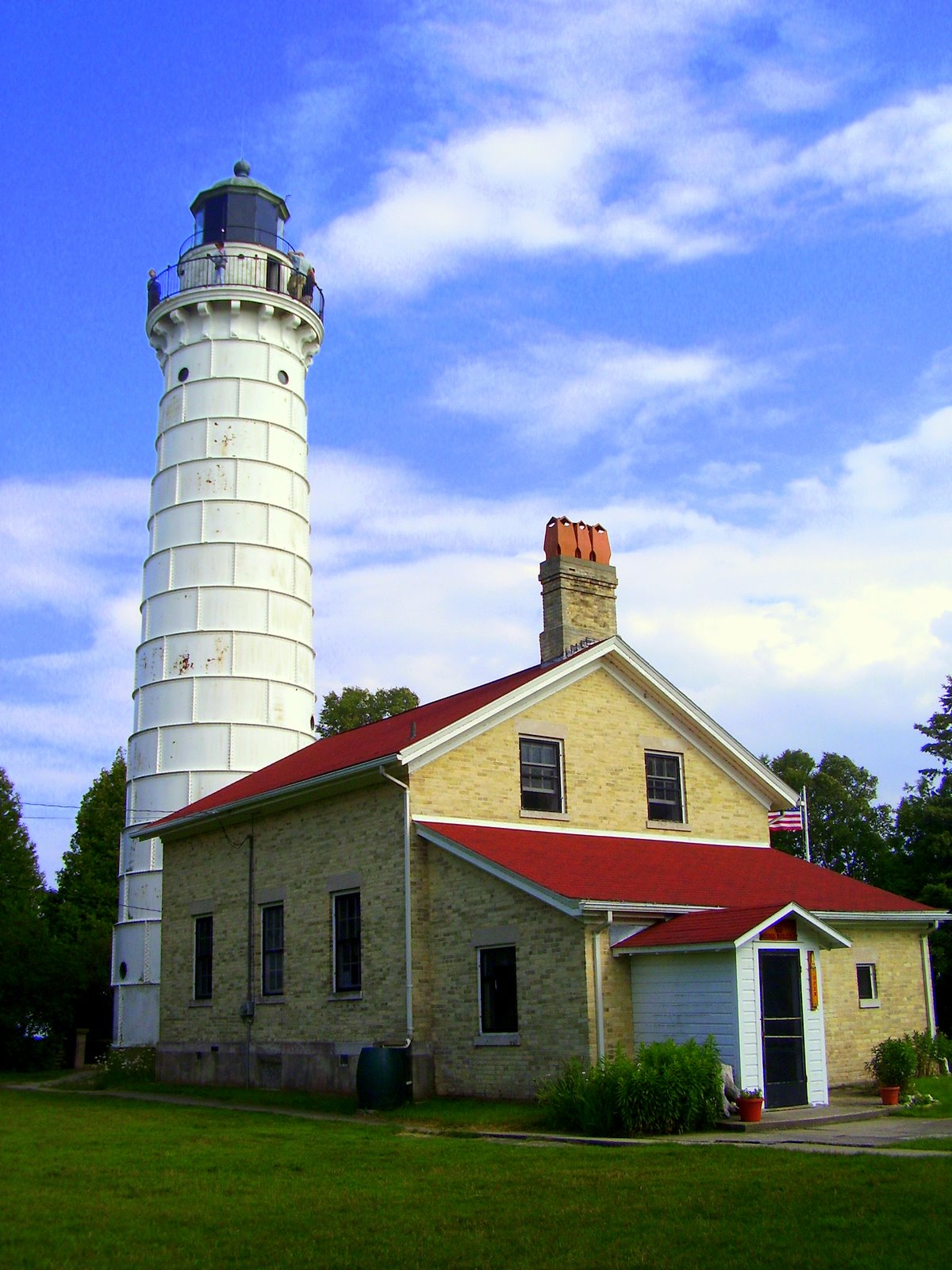
The eastern half of the peninsula, on the Lake Michigan side, was colder and more rugged, with waves crashing violently against rocks. We drove through a residential area to reach the end of the road. Then we walked through a gravel path (submerged at other times) to Cana Island and its famous lighthouse. The water was icy cold, but our feet went in for a dip anyway. We took this picture of the lighthouse when the skies cleared momentarily.
Fish Boil
In Ellison Bay, we dined at the Viking Grill, home of Door County's first commercial fish boil. It's a big show that involves boiling whitefish and potatoes in a cast-iron kettle. When they are almost cooked, the "masterboiler" pours some kerosene and the pot erupts into flames.
Served cafeteria style, the fish and potatoes come with sweet white onions, coleslaw, pumpernickel bread, lemon wedges, Kosher pickles and a piece of Door County cherry pie. It was the best meal we had on the trip.
Cherries
Speaking of cherries, did you know that only certain climates are conducive to growing cherries? The top cherry producing regions in the U.S. are Michigan, New York, Utah and Wisconsin. In Door County, the surrounding waters moderate late spring frosts as well as summer heat - keeping the area ideal for growing cherries. Visit a cherry orchard and pick them off the trees when they're fresh. Cherry harvest season starts in mid-July, but the 2010 crop ripened a few weeks earlier so we got lucky. At Door County Wildwood Market north of Sister Bay, we got a huge bucket of freshly picked cherries for around $7! There's also cherry juice, cherry jam, cherry pie filling, cherry salsa, cherry scone mix, cherry wine...
Door County is a peninsula that juts northeast into Lake Michigan. The west side, flanked by the waters of Green Bay, is warm, sunny and well protected. Tourism abounds on this side, with lots of development on the coastal route along Egg Harbor, Fish Creek, Ephraim and Sister Bay - perfect for water sports like sailing, kayaking and jet skiing (although we personally prefer non-motorized water activities).
The area's Scandinavian heritage can be seen in some of its architecture, food, gift shops and life-sized troll statues. In Sister Bay, there is a goat grazing on the roof of Al Johnson's Swedish Restaurant.
Finding a budget priced place during the holiday weekend on very short notice - and one that would accept pets - was nearly impossible. We randomly found the Maple Grove Motel in Gills Rock - just around the corner from the northernmost tip of the peninsula. Gills Rock is 10-15 minutes away from the main tourist areas - but the hassle-free view of fireworks around the corner from the motel couldn't be beat.
A few things that we discovered in Door County:
Peninsula State Park, located between Fish Creek and Ephraim, was packed with sunbathing beach goers and car campers airing out their laundry in full view. There is a nice panoramic view of Green Bay from the 76-ft. Eagle Tower observation deck. And thanks to the park guide's tip, we ventured onto Eagle Trail, a 2-mile loop with 150-foot cliffs, natural springs, lots of shade and rocky sections that hugged the shoreline. Very picturesque.
Cana Island
The eastern half of the peninsula, on the Lake Michigan side, was colder and more rugged, with waves crashing violently against rocks. We drove through a residential area to reach the end of the road. Then we walked through a gravel path (submerged at other times) to Cana Island and its famous lighthouse. The water was icy cold, but our feet went in for a dip anyway. We took this picture of the lighthouse when the skies cleared momentarily.
In Ellison Bay, we dined at the Viking Grill, home of Door County's first commercial fish boil. It's a big show that involves boiling whitefish and potatoes in a cast-iron kettle. When they are almost cooked, the "masterboiler" pours some kerosene and the pot erupts into flames.
Served cafeteria style, the fish and potatoes come with sweet white onions, coleslaw, pumpernickel bread, lemon wedges, Kosher pickles and a piece of Door County cherry pie. It was the best meal we had on the trip.
Cherries
Speaking of cherries, did you know that only certain climates are conducive to growing cherries? The top cherry producing regions in the U.S. are Michigan, New York, Utah and Wisconsin. In Door County, the surrounding waters moderate late spring frosts as well as summer heat - keeping the area ideal for growing cherries. Visit a cherry orchard and pick them off the trees when they're fresh. Cherry harvest season starts in mid-July, but the 2010 crop ripened a few weeks earlier so we got lucky. At Door County Wildwood Market north of Sister Bay, we got a huge bucket of freshly picked cherries for around $7! There's also cherry juice, cherry jam, cherry pie filling, cherry salsa, cherry scone mix, cherry wine...
Tuesday, January 18, 2011
This is what happens when ticks ruin your weekend
Having just bought our Marmot Earlylight 2-person tent, we were excited to try it out. We drove an hour south to Hawn State Park in Sainte Genevieve on Memorial Day weekend. We took the scenic route, hiking approximately eight miles before heading to campsite.
Even though we were against it, we made several applications of DEET - but the ticks wouldn't relent. The sneaky little buggers made it through my heavy duty gaiters too. It just wasn't fun anymore.
Disappointed, we headed back to the trail head, ate our Spanish rice and bean wraps on one of the picnic sites and drove back home that same night. We had just enough energy to assemble the tent in the living room which was, thankfully, quite easy to do. Then we passed out for the night.
The next day, we opted for a leisurely kayak in Forest Park. A half hour later, a thunderstorm quickly moved in. Amidst strong winds and choppy waves, it took a lot of paddling effort to get back to the Boathouse. In Forest Park, you say? Imagine that.
Even though we were against it, we made several applications of DEET - but the ticks wouldn't relent. The sneaky little buggers made it through my heavy duty gaiters too. It just wasn't fun anymore.
Disappointed, we headed back to the trail head, ate our Spanish rice and bean wraps on one of the picnic sites and drove back home that same night. We had just enough energy to assemble the tent in the living room which was, thankfully, quite easy to do. Then we passed out for the night.
The next day, we opted for a leisurely kayak in Forest Park. A half hour later, a thunderstorm quickly moved in. Amidst strong winds and choppy waves, it took a lot of paddling effort to get back to the Boathouse. In Forest Park, you say? Imagine that.
A taste of ocean sailing
South Carolina's Charleston Harbor is historically significant as a site of naval warfare during the American Civil War. Today, it home to the aircraft carrier USS Yorktown, a busy lane for cargo ships and a mecca for Charleston Race Week sailors.
I didn't realize Charleston could be so hot and humid in April. Needless to say, sailing provided a refreshing break from the heat. Even though I didn't participate in the race, I had the opportunity to sail on the ocean three times. On one occasion, we sailed the Viper 640 sport boat with the spinnaker out, heading downwind at full speed across the harbor and passing under the Cooper River Bridge. The salty spray, choppy waves and gusty winds - an exhilarating and memorable experience.
Thursday, January 6, 2011
Rugged beauty in the Central Coast
For our first vacation together, my husband (then boyfriend) and I went to California's Central Coast in late winter to explore the one of the most ruggedly beautiful places in the world.
Our trip began in the San Francisco Bay Area. We enjoyed lunch with a view of the Golden Gate Bridge through the large floor-to-ceiling windows of The Spinnaker restaurant in Sausalito. We then worked off our food walking through the Golden Gate National Recreation Area, Fisherman's Wharf and the beautiful Victorian homes on tree-lined streets.
Then we were off to the Monterey Peninsula. Our home base was at the Sandpiper Inn, a most charming bed and breakfast tucked away on a quiet street in Carmel. The innskeeper serves an organic breakfast every morning, and tea and cookies in the afternoon. There are no TVs in the room, but we didn't need it. Every morning we woke up to the sound of waves crashing on the Carmel City Beach only one street away, and that was all we needed to get out of bed and out exploring.
At Cannery Row, we rented bicycles for a 14-mile ride that hugged the Monterey coast - up north to Sand City and then back south to Pacific Grove. You'll never have parking issues - it is definitely the best way to enjoy the scenery.
The Central Coast, for lack of better words, is simply beautiful. It is a place where mountain meets ocean. The drive down to Big Sur via Highway 1 is spectacularly defined by its cliffs and rugged coastline. Inland, fog banks roll into valleys and lush forests. It's easy to feel lost in them.
On the hiking agenda were the 6.4 mile hike on the Fire Road Trail to the Tin House and the short stroll to the McWay Falls overlook at Julia Pfeiffer Burns State Park. We also headed to Los Padres National Forest, hiking the Skinner Ridge Trail to the twin summits of Devil's Peak (4137 ft) and Mount Carmel (4147 ft). It was not technically difficult, but we still gasped on the last stretch. Fog had just rolled in as we reached the summit so we missed the panoramic view of the valley below.
Our adventures had left us completely wiped out that we slept right through dinner for two nights.
We were met with a cold front on our last full day, so we opted for the easy but scenic Point Lobos State Natural Reserve, a haven for sea otters, sea lions, birds, kelp forests and more. We explored under drizzle and strong winds as the incoming storm rolled in from the ocean, bringing large waves smacking onto the rocky shore. Dramatic views at every turn.
Point Lobos has many different coves to visit. There is even a marine reserve accessible only for experienced divers. If you are visiting and don't want to stray too far away from Monterey and Carmel, you must at least visit this incredible place.
Finally, a visit to the Monterey Bay Aquarium proved to be a great way for us to read about and examine the ecosystems and animals that we encountered on our trip.
The natural beauty of this region is just so inspiring. We fell in love with the Central Coast that we decided to get married there eight months later.
Our trip began in the San Francisco Bay Area. We enjoyed lunch with a view of the Golden Gate Bridge through the large floor-to-ceiling windows of The Spinnaker restaurant in Sausalito. We then worked off our food walking through the Golden Gate National Recreation Area, Fisherman's Wharf and the beautiful Victorian homes on tree-lined streets.
Then we were off to the Monterey Peninsula. Our home base was at the Sandpiper Inn, a most charming bed and breakfast tucked away on a quiet street in Carmel. The innskeeper serves an organic breakfast every morning, and tea and cookies in the afternoon. There are no TVs in the room, but we didn't need it. Every morning we woke up to the sound of waves crashing on the Carmel City Beach only one street away, and that was all we needed to get out of bed and out exploring.
At Cannery Row, we rented bicycles for a 14-mile ride that hugged the Monterey coast - up north to Sand City and then back south to Pacific Grove. You'll never have parking issues - it is definitely the best way to enjoy the scenery.
The Central Coast, for lack of better words, is simply beautiful. It is a place where mountain meets ocean. The drive down to Big Sur via Highway 1 is spectacularly defined by its cliffs and rugged coastline. Inland, fog banks roll into valleys and lush forests. It's easy to feel lost in them.
On the hiking agenda were the 6.4 mile hike on the Fire Road Trail to the Tin House and the short stroll to the McWay Falls overlook at Julia Pfeiffer Burns State Park. We also headed to Los Padres National Forest, hiking the Skinner Ridge Trail to the twin summits of Devil's Peak (4137 ft) and Mount Carmel (4147 ft). It was not technically difficult, but we still gasped on the last stretch. Fog had just rolled in as we reached the summit so we missed the panoramic view of the valley below.
Our adventures had left us completely wiped out that we slept right through dinner for two nights.
We were met with a cold front on our last full day, so we opted for the easy but scenic Point Lobos State Natural Reserve, a haven for sea otters, sea lions, birds, kelp forests and more. We explored under drizzle and strong winds as the incoming storm rolled in from the ocean, bringing large waves smacking onto the rocky shore. Dramatic views at every turn.
Point Lobos has many different coves to visit. There is even a marine reserve accessible only for experienced divers. If you are visiting and don't want to stray too far away from Monterey and Carmel, you must at least visit this incredible place.
Finally, a visit to the Monterey Bay Aquarium proved to be a great way for us to read about and examine the ecosystems and animals that we encountered on our trip.
The natural beauty of this region is just so inspiring. We fell in love with the Central Coast that we decided to get married there eight months later.
Subscribe to:
Posts (Atom)